Best Practices for Cold Email Outreach
By Rodylyn Villaflores · Co-Founder, LastDatabase
Published: 19 Jun 2026 · Updated: 20 Oct 2026 · Views: 440
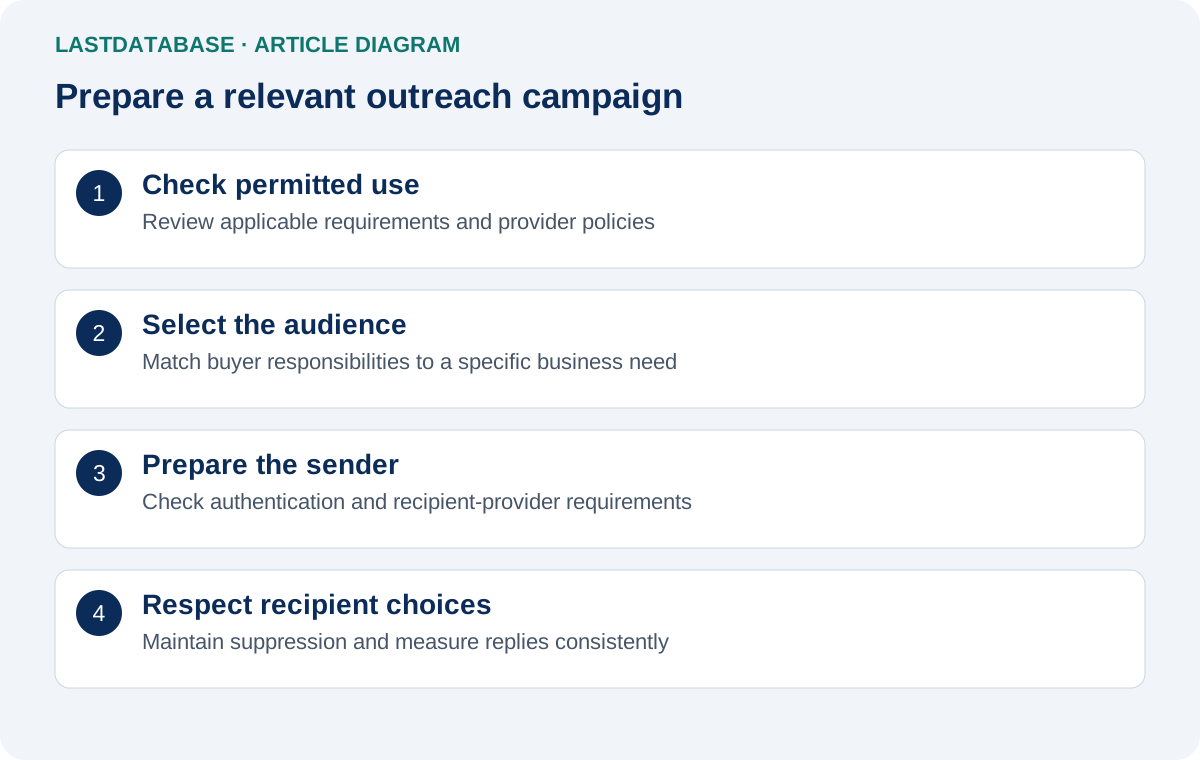
Cold email outreach needs more preparation than a contact list and a message template. Check audience relevance, permitted use, sender configuration, and recipient preferences before sending.
A valid email address does not establish permission to contact its owner. Buying a dataset does not override your sending provider's policies.
Check whether your planned outreach is permitted
Review the requirements applicable to the recipient, sender, and campaign. Requirements differ between jurisdictions and between business and consumer contacts.
Check your email service provider's acceptable-use policy. Do not assume that a technically deliverable address qualifies for a campaign.
Keep relevant source and permission information. Exclude contacts whose permitted use does not cover your intended message.
Select a relevant audience
Define the business problem your offer addresses. Choose accounts and buyer responsibilities that plausibly match that problem.
Illustrative example: A support operations tool might be relevant to someone managing customer-support workflows. A matching company industry alone does not establish that responsibility.
Remove existing customers, competitors, duplicates, and suppressed contacts according to your campaign rules.
Prepare the sending system
Check domain authentication and delivery configuration before starting. Review the recipient provider's current requirements for your sending pattern and volume.
Google publishes email sender guidelines covering authentication and other requirements for sending to personal Gmail accounts.
List replacement will not repair an authentication failure. Diagnose delivery responses before changing the audience.
Write an honest, useful message
- Identify the sender and organization clearly.
- Explain why the topic may relate to the recipient's work.
- Describe one concrete problem and a relevant next step.
- Avoid implying an existing conversation when none occurred.
- Include an accessible way to decline further outreach.
- Do not invent personal observations or customer results.
Personalization should use information you can substantiate. A job title is not proof of the recipient's current priorities.
Manage replies and suppression
Stop further campaign messages when a recipient opts out. Apply suppression consistently across future imports and campaigns.
Separate automated replies, delivery failures, objections, and positive responses. Decide how these outcomes are recorded before launch.
Use your provider's approved workflow for retries and unsubscribe handling. Do not move rejected contacts to another system to evade restrictions.
Run a controlled evaluation
Begin with a small permitted audience. Track attempted messages, final delivery failures, unique replies, and held meetings separately.
Change one major variable at a time when comparing messages. Keep the audience and reporting window comparable.
Delivery acceptance is not proof of inbox placement. An open event is not proof of buying interest.
Use the prospecting metrics guide for consistent denominators and the bounce troubleshooting guide for delivery failures.
About the Author
Rodylyn Villaflores
Co-Founder, LastDatabase
Rodylyn Villaflores is Co-Founder of LastDatabase. She contributes to LastDatabase educational content covering B2B data, lead generation, sales prospecting, data quality, and responsible data use.
View author profile →