Sales Database Guide
By Rodylyn Villaflores · Co-Founder, LastDatabase
Published: 19 Jun 2026 · Updated: 24 Oct 2026 · Views: 556
A sales database organizes company and contact information for prospecting, account research, and customer management.
A large record count does not establish accuracy, relevance, permission, or likely campaign performance. Evaluate the audience you need before comparing providers.
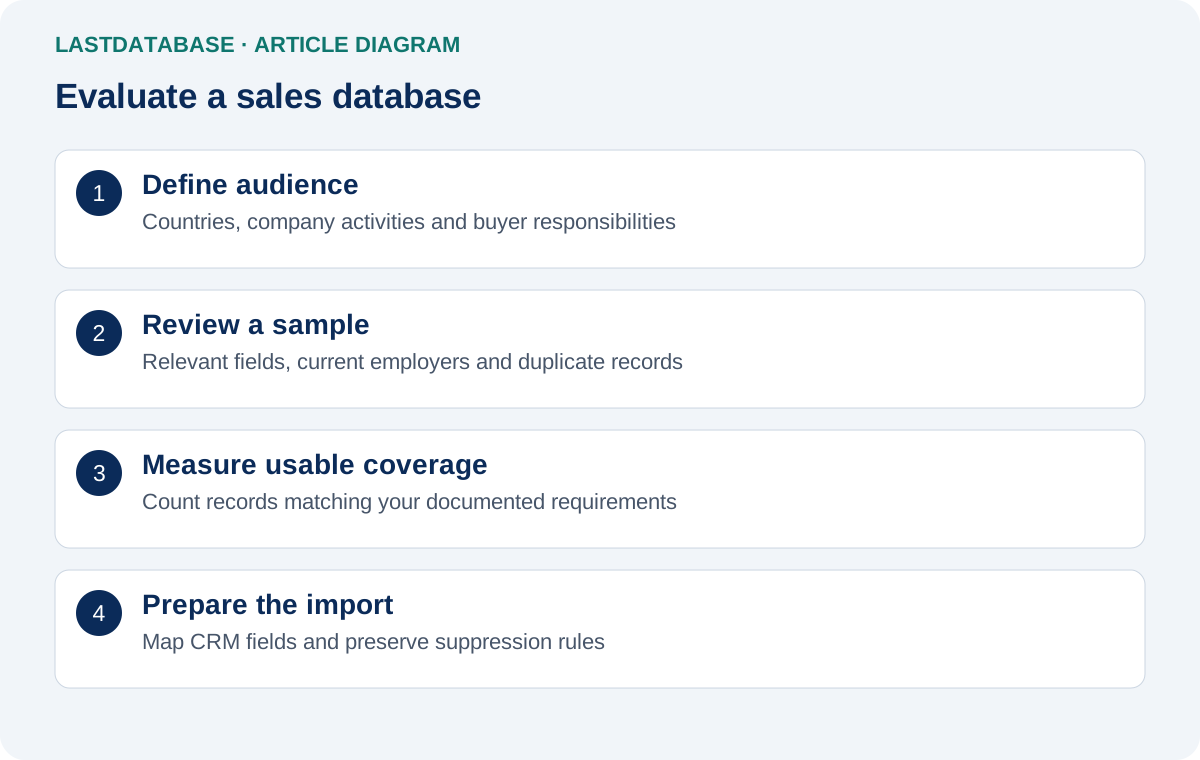
Define your target audience first
Specify countries, industries, company sizes, buyer roles, and relevant technologies. Identify exclusions, such as competitors and existing customers.
For example, a helpdesk vendor could target UK software companies and customer-support leaders. A worldwide contact list includes many unrelated prospects.
Write these criteria down. They become the rules for evaluating coverage and deciding which records are usable.
Check the fields that support your workflow
- Company and domain: Check current identity and consistent formatting.
- Contact and role: Check employer, responsibility, and relevance to the buying decision.
- Country and industry: Ask how locations and classifications are defined.
- Contact channels: Review availability, validation status, and permitted use.
- Technology information: Ask what evidence supports the classification and when it was observed.
- Source and review dates: Establish what each timestamp actually measures.
- Suppression: Check how opt-outs, corrections, and exclusions are maintained.
Field availability can vary by dataset. Do not assume every field is populated because it appears in a provider's catalog.
Evaluate a relevant sample
- Select records representative of your intended audience.
- Check whether companies, roles, and locations match your criteria.
- Measure missing fields and duplicates using documented rules.
- Review a subset against current company-published information.
- Evaluate address validation separately from employer and role accuracy.
- Record the selection method, review date, and limitations.
A small sample cannot establish the accuracy of an entire database. Report observed results without extending unsupported conclusions.
Measure usable coverage and cost
Define a usable record before comparing prices. Your definition might require audience relevance, essential fields, and no suppression conflict.
Illustrative example: You review 100 sample records. After assessing relevance, missing fields, duplicates, and exclusions, 72 remain usable.
Usable coverage is 72% under those rules. This example is hypothetical, not a LastDatabase benchmark.
Cost per usable record = total dataset cost divided by usable records.
Track cost per qualified conversation separately. A technically usable record does not guarantee interest, replies, meetings, or sales.
Distinguish freshness from import dates
Collection, import, employer research, and mailbox validation are different events. Ask which event a displayed date represents.
A recent import does not prove that someone recently checked the person's job or mailbox.
Verification can identify certain contact risks. It cannot guarantee inbox placement or establish permission to send marketing messages.
Review methodology, data sources, and data-quality documentation before relying on performance claims.
Prepare the CRM import
Map fields and normalize labels before importing. Establish duplicate rules for accounts and contacts.
Preserve available source information and review dates. Apply existing unsubscribe and suppression records before enabling outreach.
Test a small import first. Confirm field mapping, record ownership, duplicate handling, and downstream automation.
Check the LastDatabase documentation for supported access and integration workflows.
Assess permitted use
Access to contact data does not establish consent or satisfy every marketing requirement. Requirements depend on jurisdiction, channel, audience, and purpose.
The FTC's CAN-SPAM guidance covers US commercial email, including business-to-business messages. Other jurisdictions may impose different requirements.
Review compliance information and privacy controls alongside requirements applicable to your campaign.
Questions to ask before buying
- How many records match my exact audience?
- Which essential fields are populated within that segment?
- What evidence supports accuracy and freshness claims?
- How are duplicates, corrections, and opt-outs handled?
- What restrictions apply to exports and marketing use?
- What happens when records fail an agreed quality condition?
Frequently asked questions
Is the largest database always better?
No. Relevant coverage, usable fields, documented quality, and workflow compatibility matter more than headline size.
Can verified data guarantee delivery?
No. Delivery also depends on sender authentication, reputation, recipient policies, and sending practices.
Where can I explore current datasets?
Browse current data pages, country directories, and technology directories. Review each dataset's fields and access terms.
Sources
About the Author
Rodylyn Villaflores
Co-Founder, LastDatabase
Rodylyn Villaflores is Co-Founder of LastDatabase. She contributes to LastDatabase educational content covering B2B data, lead generation, sales prospecting, data quality, and responsible data use.
View author profile →